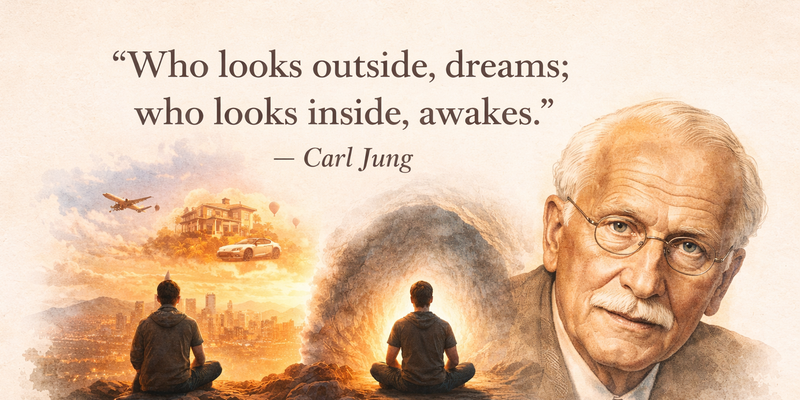
“Who looks outside, dreams; who looks inside, awakes,” wrote Carl Jung, and the line feels like a clean split between two ways of living. One is outward-facing. It is full of plans, comparisons, ambitions, and imagined futures. The other is inward-facing. It is quieter, less performative, and far more demanding. Jung’s point is not that dreams are useless. It is that a life led only from the outside remains partly asleep.Looking Outside: The Comfort of Endless PossibilityTo “look outside” is to place the centre of gravity in the external world. It is the version of you that scrolls, watches, benchmarks, collects opinions, and stays busy. Outward attention can be productive. It helps you learn skills, find mentors, notice opportunities, and build a career. But it also has a trap built into it.The trap is postponement.When the focus stays outside, life becomes a series of “once this happens” moments. Once the job changes. Once the money improves. Once the body transforms. Once the relationship feels perfect. The mind stays in projection mode. It lives in what could be, what should be, and what others seem to have figured out. That is why Jung uses the word “dreams.” A dream is vivid,… Read MoreYourStory RSS Feed