




India’s gig workers finally have a welfare board, but only Karnataka...
On Tuesday, the Karnataka government issued a notification constituting the country’s first Karnataka Platform-Based Gig Workers Welfare Development Board under the Karnataka Platform-Based Gig Workers (Social Security and Welfare Development) Act, 2025.With compulsory worker registration, mandatory platform data-sharing, and welfare levies of 1–1.5% on every payout, Karnataka becomes the first Indian state to create a formal welfare architecture for gig and platform workers—a move that quietly rewires how India’s platform economy will be governed from now on.“This is a historic and inspiring moment for millions of gig and platform workers in India,” says Shaik Salauddin, Founder President of the Telangana Gig and Platform Workers’ Union (TGPWU) and Co-founder and National General Secretary of the Indian Federation of App-Based Transport Workers (IFAT). He continues, “Karnataka has shown the way by institutionalising a welfare board that recognises gig workers as workers deserving dignity, rights, and social protection.” He adds that the Karnataka model should serve as a strong precedent for other states and the Centre to establish similar welfare boards and enact comprehensive legislation ensuring social security, fair wages, occupational safety, and grievance redressal mechanisms for gig and platform workers.What’s in itUnder the notification, the state's labour minister will serve as the ex officio… Read MoreYourStory RSS Feed

The Spain Digital Nomad Visa: A ₹2.5L+ Gateway to Europe’s Best-Kept...
In Farrukhabad district, a small printing unit finds its footing in...
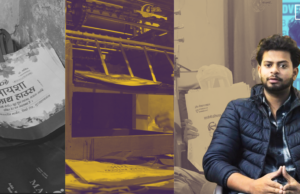
In a small locality of Farrukhabad district, Bashar Sheikh’s modest manufacturing unit is supplying printed carry bags to shops across nearby markets. The unit produces non-woven, BOPP and paper bags, mainly used by garment stores, footwear shops and agricultural retailers for packaging. Most of the demand comes from clothing shops that require customised bags with simple branding and colour preferences.Launched 3-4 months ago, this is Sheikh’s first independent business venture, and he entered it without prior experience of running a manufacturing operation. In the initial weeks, the work was limited and uneven, as he learned to manage machines, suppliers and customer expectations at the same time. As orders became regular, the pace stabilised, and the operation gradually found its rhythm.Learning to run a manufacturing setupThe production process begins with basic non-woven fabric rolls, usually white in colour. Based on a customer’s requirement, the design is finalised, and printing plates are prepared, which are sourced from Kanpur. Once the plates arrive, they are fitted into an automatic printing machine operated by a trained operator. Customers can choose between single-colour or double-colour printing depending on how simple or eye-catching they want the bags to be. Orders are supplied in bulk quantities and… Read MoreYourStory RSS Feed
Inside a Jaunpur-based effort to produce affordable household cleaners
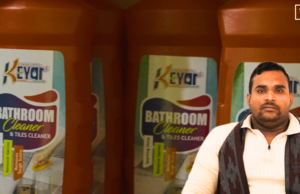
Shubham Yadav, a resident of Jagdishpur village of Jaunpur district, runs a small manufacturing unit producing everyday home-care cleaning products. His enterprise makes items such as handwash, toilet cleaner, glass cleaner, tile cleaner, and dishwashing liquid, all meant for routine household use. The focus, he says, is on supplying basic cleaners at prices that local customers can afford, in a market otherwise dominated by costlier national brands.Hailing from a farming family, Yadav has BCom degree and an LLB degree. In fact, he also practises as an advocate on a part-time basis. After finishing his studies, he moved to Delhi in search of employment, attending several interviews, but steady work proved difficult to secure. Eventually, he returned to his home district and began looking for a business option that could be started locally and sustained over time.Choosing a daily-use businessThe idea of manufacturing cleaning products emerged from observing everyday consumption patterns. Yadav explains that household cleaners are items people cannot do without, regardless of income level or season. “From washing hands to cleaning the bathroom and utensils, these are things used every day,” he says, noting that this consistency made the sector practical for a small, local operation.Production involves sourcing raw materials, bottles, containers, and… Read MoreYourStory RSS Feed